
AdVenture Ages: Idle Clicker
Hyper HippoSimulation
4.32.38K Reviews
- Version
- 1.35.0
- Installs
- 1.00M
- Age Rating
- Everyone
Screenshots

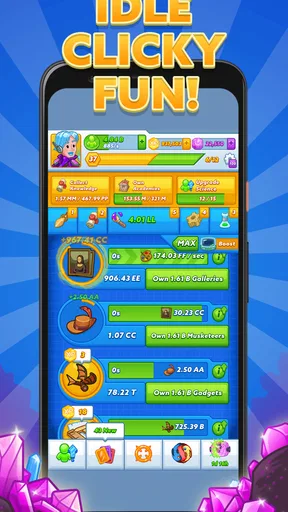



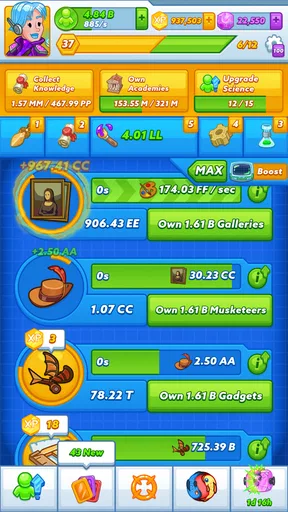
Our Review of AdVenture Ages: Idle Clicker
 Analysis by Appyee
I approached AdVenture Ages: Idle Clicker expecting a light simulation game that could fill a few spare minutes, and that is exactly where it fits best. It is built around gradual progress rather than quick reflexes: I check the game, improve my production, collect what has accumulated, and decide where the next upgrade will have the most impact. The result is easy to understand at first, but it gradually asks for more thoughtful choices as several parts of the simulation begin competing for attention.
The game comes from Hyper Hippo and is free to download, with optional in-app purchases ranging from $0.49 to $94.99 per item. I would describe it as a relaxed idle simulation game for people who enjoy watching a small system grow over time. It is rated for Everyone, and its broad appeal comes from the fact that you can make progress with short visits instead of committing to long sessions.
Its public reception also suggests that it has found a sizeable audience: the game has passed 1 million installs, with an average rating of 4.3 from around 38 thousand ratings and roughly 2.4 thousand written reviews. Those figures do not replace personal experience, but they match my impression that this is a polished, accessible entry in the idle-game space rather than an obscure experiment.
Getting comfortable with the time-machine loop
The central idea is straightforward. You build a historical progression through an idle economy, collect resources, improve the parts that generate them, and unlock further opportunities as your account develops. The “time machine” theme gives the progression a recognizable direction, but the important thing for a new player is the rhythm: open the game, gather accumulated rewards, spend carefully, and leave it running in the background of your day.
That rhythm makes the game different from a traditional management simulation. In a conventional strategy game, I might need to remain present to assign workers, respond to events, or protect a settlement. Here, the satisfaction comes from returning to a system that has continued moving without constant supervision. It is closer to tending a small digital garden than commanding a complex operation in real time.
For a first-time player, the opening can feel busier than the basic concept suggests. There are several upgrade choices and progress screens, and the game encourages you to keep moving forward. My advice is not to treat every button as equally urgent. Follow the obvious early objectives first, learn what each resource is used for, and resist spending everything immediately just because an upgrade is available.
The most useful mental model is to separate short-term acceleration from long-term progress. A purchase that makes the next few collections faster can be valuable, but it may not be the best choice if another improvement unlocks a new production path or increases the value of everything you already own. I found that pausing for a moment before each larger upgrade reduced wasted spending and made the system easier to read.
What happens during the first few minutes
At the start, the game gives you a clear sense of forward motion. Early rewards arrive frequently, so you can make several improvements without waiting very long. This is helpful because it teaches the basic loop through action rather than a long tutorial. I could see the connection between collecting, upgrading, and unlocking almost immediately.
The first session is best treated as a guided tour. Tap through the available objectives, inspect the upgrade screens, and notice which actions produce immediate rewards. You do not need to understand the entire economy before making progress. The game is designed to reveal its layers gradually, and trying to plan the whole campaign from the opening screen only creates unnecessary confusion.
One practical tip is to check the result of an upgrade before buying the next one. Some improvements feel powerful because they are inexpensive, while others matter because they affect the rate at which later rewards arrive. Comparing the visible effect of two affordable choices is more useful than automatically selecting the one with the most attractive icon or largest-looking number.
I also recommend making the first session long enough to complete a few connected objectives, but not so long that the game becomes a chore. The appeal of this title depends on returning at comfortable intervals. If you spend too much time repeatedly collecting tiny amounts, you may miss the reason idle games work: the pause between visits is part of the design.
How to reach the first meaningful success
The first meaningful success is not simply unlocking one more item. It is reaching the point where your production begins to feel self-sustaining. You collect enough to make an upgrade, that upgrade improves the next collection, and the improved income lets you make another meaningful decision. Once that cycle starts, the game becomes much more satisfying.
To get there, I would use a simple three-step routine. First, collect everything currently available. Second, inspect the cheapest upgrades that improve your active production. Third, check whether an objective or milestone is close enough to complete with one additional action. This avoids scattering resources across too many unrelated improvements.
A common beginner mistake is spending only according to price. The least expensive upgrade is not always the best first move. If a slightly more expensive option improves a more important part of the current production chain, saving for it can shorten the time to the next milestone. The game rewards patience in small doses, even though its interface constantly invites you to tap something immediately.
Another useful habit is to stop after a strong upgrade and let the game work. I found that repeatedly opening menus right after improving production made the progress feel slower, not faster. Leaving the game alone for a while creates a clearer before-and-after comparison when you return. That is one of the quiet strengths of the idle format: the best action is sometimes to do nothing for a little while.
For an everyday example, imagine checking the game during a morning commute, collecting the accumulated resources, and buying one production improvement before putting the phone away. At lunch, you return to a larger balance and use it to complete an objective. In the evening, you can make a more substantial upgrade without having spent the entire day actively tapping. That pattern suits players who want a game that fits around their schedule rather than taking over it.
Where new players commonly get confused
The biggest source of confusion is usually not the basic loop but the number of choices that appear around it. Idle games often present several currencies, progress indicators, and upgrade routes at once. When that happens here, I recommend focusing on the screen that directly improves the resource you are currently collecting. If a menu does not help you understand your next action, leave it for later.
It is also easy to mistake activity for progress. Opening every panel and claiming every small reward can feel productive, but the important question is whether the action improves your future income or helps complete a meaningful objective. I began making better decisions once I stopped measuring success by how many buttons I pressed and started looking at how much stronger the next collection became.
Another point worth understanding is that idle progress does not remove the need for decisions. The game may continue generating rewards while you are away, but returning to collect them is only half the process. You still need to decide where to invest them. Players who expect a completely automatic experience may find the upgrade planning more involved than anticipated, while players who enjoy light optimization will probably appreciate that extra layer.
The free-to-play structure deserves a realistic explanation as well. You can begin without paying, and the core appeal is available through ordinary play. However, optional purchases can make the route feel faster or more convenient. I would approach them as acceleration rather than a requirement. If you enjoy the satisfaction of building progress gradually, spending is unnecessary. If waiting bothers you, the presence of purchasable boosts may make the balance feel less comfortable.
My practical rule is to avoid buying anything during the opening excitement. Play long enough to understand whether the idle pace suits you. A purchase cannot fix a mismatch between your preferred style and the game’s design. If you want constant action, deep tactical combat, or a story that drives every session, this is probably not the right choice regardless of how quickly you can advance.
How it compares with other simulation choices
Compared with a traditional city builder, this game asks for much less direct management. You are not expected to design streets, balance a population, or react to a detailed map. That makes it easier to play in short bursts, but it also means there is less room for creative construction. I would choose a city builder when I want to shape a place personally; I would choose this game when I want a clear progression system that keeps moving between visits.
Compared with a clicker focused almost entirely on repeated tapping, the time-machine structure gives the progress a stronger sense of direction. The historical framing helps each stage feel like part of a larger journey instead of an endless number going upward. Still, it remains an idle game at heart, so players who dislike incremental upgrades may find the repetition too familiar.
It also differs from a competitive strategy game because the pressure is much lower. There is no need to maintain constant awareness of opponents in the way I would in a live multiplayer title. That is a major advantage for casual players, parents, commuters, and anyone who wants a game that can be paused without penalty. The trade-off is that the experience is less dramatic; its rewards come from steady accumulation rather than sudden victories.
Small habits that make the progression smoother
I found three habits especially useful. The first is to group actions into visits: collect, review objectives, make one or two purposeful upgrades, then leave. This keeps the game from turning into a repetitive minute-by-minute chore.
The second is to save enough for a clearly stronger upgrade instead of emptying the balance after every collection. This is particularly helpful when two upgrade paths appear close together. Keeping a reserve gives you flexibility and makes the next return more rewarding.
The third is to use objectives as a guide, not as an absolute command. They can point you toward productive actions, but blindly chasing a task may lead you to ignore a better upgrade. When an objective and your economy point in different directions, I prefer the action that strengthens future production unless the objective is nearly complete.
These habits are not complicated, but they change the feel of the game. Without them, the interface can encourage scattered spending. With them, each visit has a beginning, a decision, and a clear stopping point. That structure is valuable for anyone who wants to enjoy an idle game without checking it constantly.
Who should try it and who should skip it
I think the game is a good match for someone who enjoys incremental progress, light resource planning, and a historical theme that gives the upgrades a sense of sequence. It works particularly well for players who want something they can open during short breaks and leave alone afterward. The Everyone age rating also makes its presentation broadly approachable.
I would be more cautious recommending it to anyone who needs a strong narrative, complex simulation, or a finish line that arrives quickly. The progress is intentionally gradual, and the most satisfying moments depend on accepting that pace. Players who dislike waiting, repeated collection, or optional purchase prompts may become frustrated even if they understand the mechanics.
It is also not the best alternative for someone looking for a highly creative sandbox. You will make strategic choices about improvement, but the joy comes from optimizing a guided progression rather than inventing an entirely personal world. A deeper management game will offer more control; this one offers more convenience.
Device and version details worth knowing
The game supports Android devices running version 7.0 or later. Its current version is 1.35.0, so anyone installing it should make sure their device meets that minimum requirement before expecting a smooth start. I would also keep some patience for updates and adjustments, since idle games depend heavily on balancing progression so that early rewards feel generous without making later development meaningless.
Because it is free to start, the sensible approach is to install it and test the first progression cycle before deciding whether it belongs in your regular rotation. The opening is friendly enough for newcomers, but the real question is whether you enjoy returning to improve a system rather than actively controlling every moment.
My recommendation after settling into the routine
AdVenture Ages: Idle Clicker succeeds because it understands the value of small sessions. I can collect progress, make a meaningful upgrade, and leave without feeling that I abandoned an urgent task. The historical theme gives the numbers a little more personality, while the simulation structure keeps the controls approachable.
Its limitations are equally clear. The game can become repetitive if I treat every visit as a demand for constant tapping, and the optional purchases may not appeal to players who prefer a completely even pace. The upgrade choices are more interesting when I slow down and compare them, but anyone seeking deep strategic complexity will eventually want something more demanding.
For a first-time user, my recommendation is to follow the early objectives, learn which improvements affect your current production, and establish a simple visit routine instead of trying to master every screen immediately. Reach the first self-sustaining cycle, then decide whether the gradual rhythm feels rewarding. If it does, this is an easy game to keep nearby for commutes, waiting rooms, and quiet evening breaks.
Hyper Hippo has made a simulation that is welcoming without being entirely mindless. I would recommend it to a friend who wants a calm progression game with decisions between idle periods, especially if that friend enjoys watching a small economy grow over time. I would not recommend it to someone who wants constant action or detailed hands-on management. Knowing that distinction before installing is the best way to get the most from it.
Verdict
Strengths of AdVenture Ages: Idle Clicker
- Simple idle mechanics make it easy to progress with little active play.
- Multiple historical eras provide varied visuals, characters, and upgrade paths.
- Offline earnings let you collect resources even when you are not playing.
- Frequent missions and events give short-term goals beyond basic progression.
- The interface is clear and works well on smaller mobile screens.
Limitations of AdVenture Ages: Idle Clicker
- Progress can slow noticeably unless you spend premium currency or wait.
- Energy and timed systems may interrupt longer play sessions.
- Random rewards can make specific upgrades difficult to obtain.
- Ads and optional purchases may feel prominent during resource management.
- Late-game progression can become repetitive after the main eras are unlocked.
Other Releases by Hyper Hippo
View All
AdVenture Capitalist
Simulation4.5

AdVenture Communist
Simulation4.3
Similar Picks in This Category
View All
Truckers of Europe 3
Wanda Software4.3

Town Building Life Simulator
XGame Global4.2

Fidget Toys Trading・Pop It 3D
Freeplay Inc4.7

Sculpt People
CrazyLabs LTD4.4

Scary Teacher 3D
Z & K Games4.2

Hair Tattoo: Barber Shop Game
CASUAL AZUR GAMES4.3
Frequently Asked Questions
What is AdVenture Ages: Idle Clicker?
AdVenture Ages: Idle Clicker is an idle progression game where you rebuild history by managing different eras, collecting resources, and upgrading time-traveling heroes. The game continues generating rewards while you are away, so you can return later to claim progress. Its main appeal is the combination of simple tapping, automated income, humorous presentation, and long-term upgrade goals.
How does the gameplay work in AdVenture Ages?
The gameplay centers on unlocking historical ages, assigning heroes, improving production, and completing objectives to advance through the campaign. You can tap or interact manually when you want faster progress, but most resources are earned automatically over time. As new eras and characters become available, you gradually build a stronger production system and use collected currency to increase efficiency.
Is AdVenture Ages: Idle Clicker free to download and play?
AdVenture Ages is generally free to download and play, allowing you to experience its core progression without paying upfront. However, it includes optional in-app purchases that can provide premium currency, boosts, bundles, or convenience features. Advertising may also be part of the experience, depending on the platform and current version. You can make progress without spending, although patience is often required.
Does the game require an internet connection?
An internet connection may be needed for certain features, such as advertisements, cloud-related services, special events, updates, and purchases. Some basic idle progress may appear to work while offline, but the complete experience can depend on connecting to the game’s servers. If you plan to play during travel or without reliable data, check how the current version handles offline rewards before downloading.
Is AdVenture Ages suitable for casual players?
AdVenture Ages is well suited to casual players who enjoy short sessions and gradual progression rather than fast, competitive action. You can check in briefly, collect accumulated earnings, upgrade characters, and leave again. The game is less appropriate for players who dislike repetitive resource management, waiting timers, advertisements, or optional purchases, since these elements are closely connected to its idle-clicker design.
Play our best games!


